
TL;DR
- Personal Element: Flushing my SSRI in a hotel bathroom with no doctor and no plan — and a loss closer to home that didn't end as luckily.
- What It Means: Nobody coordinated what was actually in my system — SSRIs, supplements, psilocybin — and that gap, not the drug itself, was the real danger.
- Proof or Evidence: CDC antidepressant-use data and a 2023 Nature Neuropsychopharmacology study on SSRIs blunting psilocybin response.
I've written before about the night I ended up in the ER, sure I was having a heart attack. Heart was fine. It was a panic attack — years of running from one thing to the next, finally catching up with me. What I haven't told you is what happened next: the part I'm less proud of, and probably the more useful part.
The Toilet in Paradise
My therapist sent me to a psychopharmacologist. He put me on an SSRI — one of the harder-hitting ones. Within days I had what's clinically called "brain zaps": a jolt like someone flicking a light switch inside your skull, at random, sometimes dozens of times a day. Nobody warned me that might happen. It's disorienting in a way you can't really explain unless it's happened to you.
Three days into the prescription, I left for a long-planned trip with old friends — sun, ocean, the vacation that's supposed to fix everything. I was worried the darkness would follow me there anyway. First night, standing in the hotel bathroom, I made the call myself. No doctor on the phone. I flushed the pills.
I'd done a bit of reading — this was pre-ChatGPT, so "a bit" meant an evening of forum posts — and I knew going off an SSRI cold wasn't smart. Didn't care. I wanted the zaps gone more than I wanted to do it right.
I got lucky. Three days is short enough that I never hit a real withdrawal. Antidepressant discontinuation syndrome is a real thing, and it can be brutal. The zaps that pushed me to flush the pills are actually one of its classic symptoms — they don't just stop the second you stop the drug. I didn't know that going in. I only know it now because I got away with it.
The Part I'm Less Proud Of
The natural-supplement route we rebuilt me with — L-tryptophan and St. John's Wort — worked. Three or four weeks and the cloud lifted. I've told that part before, as a happy ending. It was.
The part I left out: L-tryptophan and St. John's Wort together aren't risk-free either. Both push up serotonin, and stacking them can cause serotonin syndrome — the same dangerous overload SSRIs and MAOIs cause together. Confusion, seizure, a dangerously high fever, and in bad cases, death. I didn't know that either. Nobody was coordinating the psychopharmacologist, my regular doctor, and whoever sold me the supplements that week. I was the only one holding the whole picture, and I was holding it badly.
It was the psilocybin retreat months later that actually became the firewall. But the two years in between ran on a stack of stuff I'd put together myself, with nobody else tracking how it fit.
I've since heard versions of this from friends and family — people adjusting their own doses, stopping cold, adding something new, never looping in whoever wrote the prescription. Some got away with it, the way I did.
One of the people closest to me didn't. She'd been on and off an SSRI on her own schedule since 2013. At some point her behavior got erratic enough that I asked her — as gently as I knew how — whether she should actually be talking to her doctor about tapering off properly, instead of stopping and starting on her own. She told me it wasn't necessary. She died by suicide in 2024.
I will never know how much of what I saw in her — the swings between mania and depression — came from managing her own medication, how much came from drinking on top of it, and how much would have happened regardless. Nobody can answer that with certainty, and I'm not going to pretend I can. What I do know is that the research on this specific point is real, even if her specific case will always be a question mark. Stopping and restarting an SSRI on your own can trigger a manic or mixed episode, especially in people whose underlying condition was never fully worked up — one review found SSRIs behind more than half of the documented cases of discontinuation-triggered mania, often within two weeks of the taper starting. And alcohol on top of an antidepressant doesn't just take the edge off — it measurably worsens depression, makes the medication work less well, and increases impulsivity. I can't tell you that's what happened to her. I can tell you it's real, documented, and exactly the kind of thing a doctor who saw her whole picture might have caught.
If you're in a crisis right now, or you're worried about someone who might be, call or text 988. The Suicide & Crisis Lifeline is free, confidential, and available around the clock — you don't have to be in immediate danger to call.
What happened to her isn't rare, and it isn't small.
This Is Bigger Than My Story
Nearly 13% of Americans over 12 say they're on an antidepressant in a given month, per CDC data — up from 7.7% at the turn of the century. One in four of those people has been on it for ten years or more.
Europe tracks this differently — not by what percentage of people say they take a pill, but by total dose volume — and it points the same way. Average antidepressant use across 18 European countries nearly doubled between 2000 and 2020. Iceland, the UK, Sweden, Canada, and Portugal are now among the heaviest users anywhere. The two ways of counting aren't directly comparable, but they're not telling different stories: on both sides of the Atlantic, being on an antidepressant long-term has become normal in a way it wasn't a generation ago.
The New York Times ran a major investigation into this in 2018 and put a number on the thing I lived through by accident: by then, nearly 25 million American adults had been on antidepressants for at least two years — up 60% since 2010 — and a lot of the people trying to quit were finding withdrawal symptoms nobody had warned them about. Over 8,800 readers wrote in with their own version of what happened to me.
This coordination gap isn't unique to psychiatric drugs, either. Study after study finds that specialists routinely aren't looped in on what the other one prescribed — patients pick up medications from multiple doctors who don't share a list, and no pharmacist is reliably closing that gap. When one of those drugs is a serotonergic antidepressant, the chance of a bad interaction stops being theoretical.
SSRIs aren't bad drugs, to be clear. For a lot of people they work, and work well — quitting a medication that's actually helping you because of a late-night internet spiral is its own kind of risk. The FDA slapped a black-box warning on antidepressants and suicidality back in 2004 — a call people are still fighting about twenty years later — because these are not gentle drugs, in either direction. Common side effects: sexual dysfunction (somewhere between 30 and 70% of users, depending on the study), emotional blunting, weight gain, and — like I found out — withdrawal on the way out. How common severe withdrawal actually is depends on who you ask: a widely cited 2019 review put it at 56% of people getting some withdrawal, with about 46% of those calling it severe — a number other researchers think is inflated. Nobody's arguing withdrawal isn't real. They're arguing about how big the problem is. Either way, that's not a reason to panic. It's a reason to know exactly what's in your system, tell every doctor about all of it, and never make the kind of solo, three-day, hotel-bathroom call I made.
What Actually Interacts With These Drugs
This is the part I actually sat down to write, because I couldn't find it in one place when I needed it.
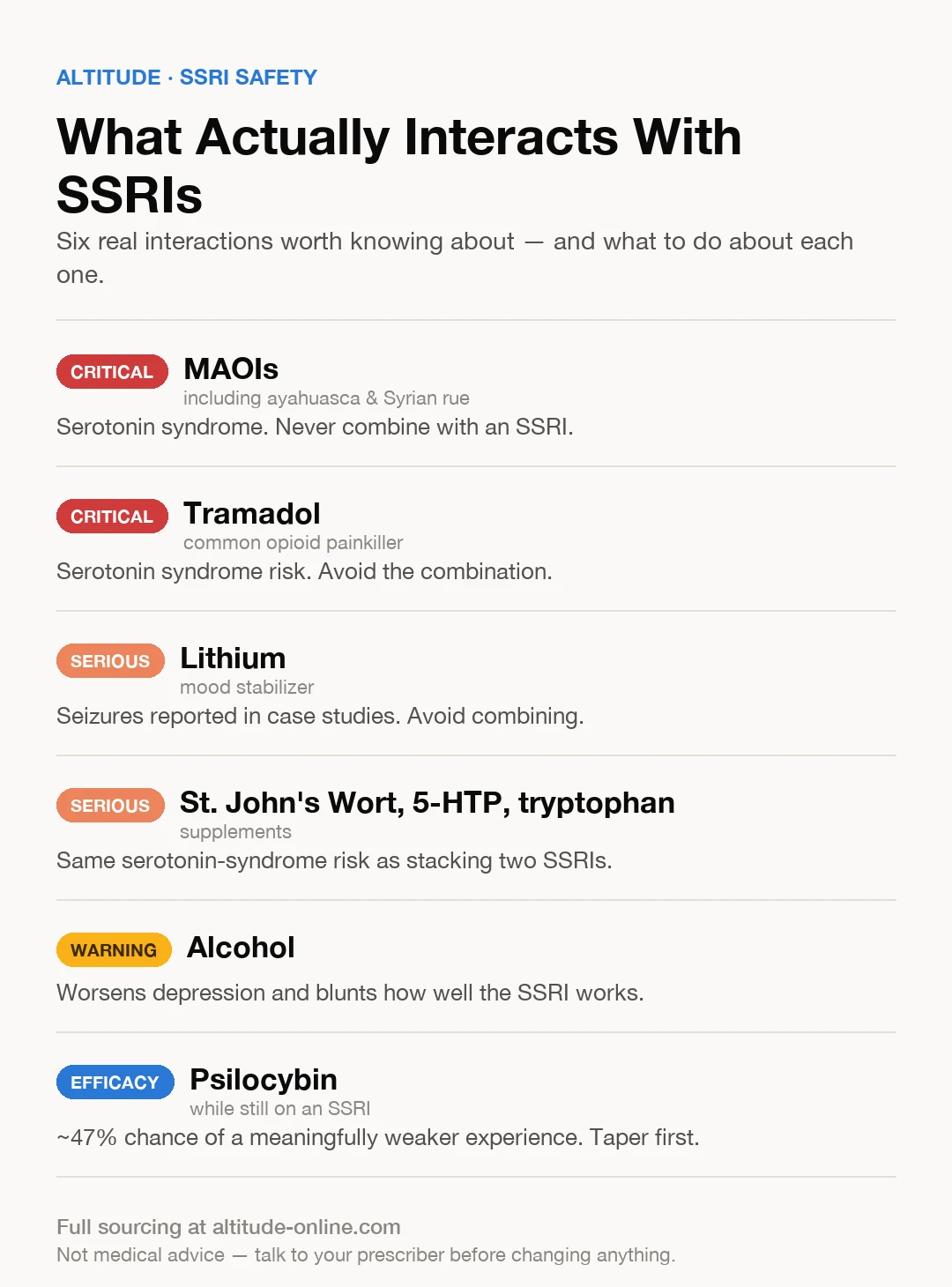
The mechanism to know is serotonin syndrome: too much serotonin, stacked from more than one source, faster than your body can clear it out. It's rare. It's also why a handful of very ordinary combinations are genuinely dangerous, not just "ask your doctor first" territory:
MAOIs. Including the plant-based ones. Ayahuasca and Syrian rue both work by inhibiting monoamine oxidase, and stacking that with an SSRI, or with most other serotonergic psychedelics, is one of the best-documented ways to get seriously hurt in this space. Not a "weaker trip" interaction — a dangerous one.
Tramadol. A common opioid painkiller that also blocks serotonin reuptake. There are enough case reports of serotonin syndrome from tramadol plus an SSRI that most guidance says avoid it outright, not just watch for symptoms.
Lithium. Combined with an SSRI or a psychedelic, it's been tied to seizures in case reports. Generally flagged as avoid, not manage.
St. John's Wort — the same supplement that helped rebuild me — is a serotonergic agent in its own right. Stack it with an SSRI, or with tryptophan like I did without knowing better, and you're running the same risk as stacking two pharmaceuticals.
And the one that matters most if you're reading Altitude: chronic SSRI use blunts psilocybin. SSRIs downregulate the exact receptors — 5-HT2A — that psilocybin needs to do its thing. A 2023 study of psilocybin therapy in people still on an SSRI found roughly a 47% chance the experience came out meaningfully weaker, and that blunting can hang around for up to three months after you stop the antidepressant. The good news: the same research suggests it doesn't necessarily blunt the actual therapeutic benefit — but the experience itself can get quietly muted by a drug that's still in your system from months back. This is why real psilocybin trials make people taper off under supervision first — typically two weeks for most SSRIs, four-plus for fluoxetine specifically, since it hangs around in the body way longer than the others — instead of letting people just stop the week before. If a clinical protocol won't let you skip that taper, you shouldn't either.
You don't need to be scared of SSRIs, or psychedelics, or the space in between. Write the whole list down, hand it to every prescriber and every guide, and let someone whose actual job is the pharmacology look at the full picture instead of just their piece of it.
Why I'm Excited About What's Coming
What actually gives me hope isn't "everyone should quit their SSRI and go find a shaman."
It's that what's coming through trials right now doesn't work like SSRIs do, structurally. SSRIs need daily dosing and weeks to kick in because they're slowly nudging a system that adapts right back around them — which is also exactly why quitting them is such an ordeal. The new stuff is different in kind, not just in degree. Zuranolone, the first oral neurosteroid antidepressant, works on GABA-A receptors instead of serotonin reuptake and shows separation from placebo in days, not weeks. It's already FDA-approved for postpartum depression, with trials in general depression ongoing. Psilocybin and 5-MeO-DMT still touch the serotonin system, but through direct receptor agonism in a single session instead of chronic reuptake blocking — closer to resetting something stuck than managing it forever. And the regulatory system is finally starting to move at the same speed as the science: faster review pathways, priority vouchers, a whole generation of trials asking whether one guided afternoon can do what SSRIs are built to do, imperfectly, over years.
I'm not saying any of this is proven at scale — most of it isn't, and I've written elsewhere about why the evidence bar needs to stay high. But mechanism diversity is exactly what a field with basically one tool has been missing. My own experience is a sample size of one, but for what it's worth: the SSRI managed my symptoms for three days before I couldn't take it anymore. The single psilocybin session is the thing that's actually held, years later. I want more people to have more than one tool available before they're standing alone in a hotel bathroom making a call like I made.
The Actual Lesson
I'm not a doctor. Nothing here replaces one. If you're on an SSRI and it's working, that's not a problem — keep taking it, and talk to your prescriber before you change anything, including supplements you'd never think to mention. If you're thinking about stopping, taper with medical supervision. Don't do what I did in that bathroom. If you're considering psilocybin while on or recently off an antidepressant, tell the people running it exactly what's in your system and for how long, and respect a taper requirement if they give you one.
The lesson isn't "trust your gut over your prescription." It's that I got lucky on bad information, more than once. Not everyone I know did.
This article is for educational purposes only and does not constitute medical advice. Never stop, start, or combine an antidepressant, supplement, or psychedelic without consulting a qualified prescriber who has your complete medication list. Serotonin syndrome and antidepressant discontinuation syndrome are both potentially serious conditions — seek medical care if you experience symptoms of either. If you are having thoughts of suicide, or are worried about someone who might be, call or text 988 (the Suicide & Crisis Lifeline) or contact emergency services. It is free, confidential, available 24/7, and you do not need to be in immediate danger to call.
Sources
- Carey, B., & Gebeloff, R. (2018). Many People Taking Antidepressants Discover They Cannot Quit. The New York Times, April 7, 2018.
- Stuck on meds: Some can't quit antidepressants. NBC News, coverage of reader response to the Times investigation.
- CDC/NCHS antidepressant use data, cited in AHA News, "CDC: Antidepressant use up 65% over 15 years", 2017.
- Patterns of Antidepressant and Anxiolytic Use in 14 European Countries (2012–2021): A Comprehensive Time Series Analysis. PMC.
- In SSRI Withdrawal, Brain Zaps Go from Overlooked Symptom to Center Stage. The Journal of Clinical Psychiatry news coverage.
- Barriers and Facilitators of Communication in the Medication Reconciliation Process during Hospital Discharge. PMC.
- Davies, J., & Read, J. (2019). A systematic review into the incidence, severity and duration of antidepressant withdrawal effects. Addictive Behaviors, 97, 111-121.
- Spielmans, G. I., Spence-Sing, T., & Parry, P. (2020). Duty to Warn: Antidepressant Black Box Suicidality Warning Is Empirically Justified. Frontiers in Psychiatry, 11, 18.
- Complementary Corner: St John's Wort and Serotonin Syndrome. Medsafe (New Zealand Medicines Safety Authority).
- Halman, A., Kong, G., Sarris, J., & Perkins, D. (2024). Drug–drug interactions involving classic psychedelics: A systematic review. Journal of Psychopharmacology, 38(1), 3-18.
- Becker, A. M., et al. Psilocybin for treatment resistant depression in patients taking a concomitant SSRI medication. Neuropsychopharmacology (2023).
- Efficacy and tolerability of zuranolone in patients with depression: a meta-analysis of randomized controlled trials. PMC.
- Goldstein, T. R., Frye, M. A., Denicoff, K. D., et al. (1999). Antidepressant discontinuation-related mania: Critical prospective observation and theoretical implications in bipolar disorder. Journal of Clinical Psychiatry, 60(8), 563-567.
- National Institute on Alcohol Abuse and Alcoholism. Alcohol-Medication Interactions: Potentially Dangerous Mixes.
- 988 Suicide & Crisis Lifeline — free, confidential, 24/7 support by call, text, or chat.