
An estimated 19.1% of US adults had an anxiety disorder in the past year, and 31.1% will have one at some point in their lives, per the National Institute of Mental Health. Only about 37% of them get any treatment at all. And here's the part that surprised us most while researching this: no pharmaceutical company currently reports meaningful revenue from a branded, on-patent anxiety drug. Every major anxiolytic on the market — buspirone, Xanax, Klonopin, Ativan, Valium, the SSRIs and SNRIs doctors reach for first — is a decades-old generic, most of them off-patent for 15 to 30 years. Mental-health prescribing in the US now runs as high as 99% generic, per IQVIA. That's a real, underserved, commoditized market — which is exactly the setup that makes DT120, Definium's LSD candidate now sitting on two positive Phase 3 trials, worth taking seriously as a business story, not just a clinical one.
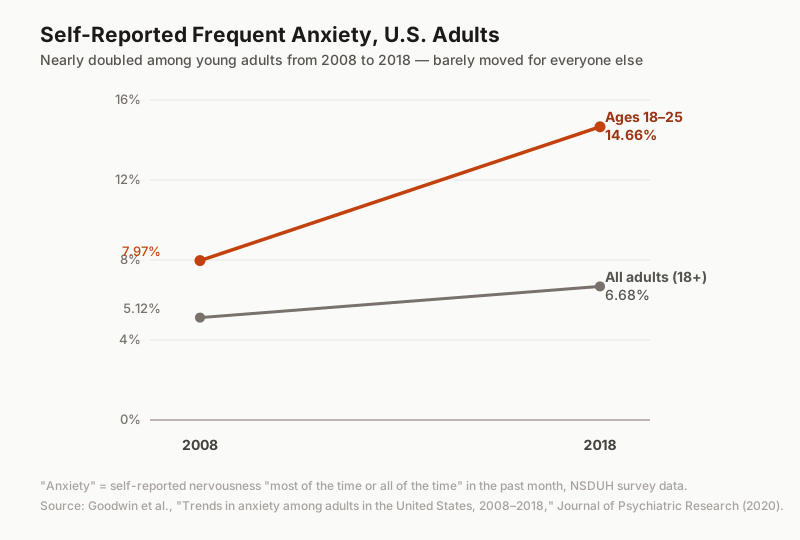
Source: Goodwin et al., "Trends in anxiety among adults in the United States, 2008–2018," Journal of Psychiatric Research (2020), using National Survey on Drug Use and Health data.
What's Actually Being Prescribed Today
Five core anxiolytics accounted for roughly 53.5 million US prescriptions in 2024, per ClinCalc's prescription database (built on AHRQ's Medical Expenditure Panel Survey). Every one of them is fully generic, most for decades:
| Drug | Class | Generic Since | Years Off-Patent | Implied US Annual Retail Spend* |
|---|---|---|---|---|
| Buspirone (BuSpar) | Azapirone | 2001 | ~25 years | ~$297M |
| Clonazepam (Klonopin) | Benzodiazepine | 1997 | ~29 years | ~$156M |
| Alprazolam (Xanax) | Benzodiazepine | 1993 | ~33 years | ~$123M |
| Lorazepam (Ativan) | Benzodiazepine | 1985 | ~41 years | ~$82M |
| Diazepam (Valium) | Benzodiazepine | 1985 | ~41 years | ~$32M |
*Implied spend = 2024 prescription volume × average total cost per prescription, both from ClinCalc's DrugStats database. That's a proxy, not an official market-size figure, but it's the closest real approximation available for drugs this commoditized — and no single company reports it, because no single company owns any of it anymore. All five combined imply roughly $690 million in total US annual retail spend, spread across 53.5 million prescriptions and dozens of generic manufacturers — smaller than what one mid-size branded drug can generate on its own.
That figure excludes SSRIs and SNRIs like sertraline and venlafaxine, also commonly prescribed for anxiety but not cleanly separable from their depression-indication volume in public data. Retail prices for some of the five above have fallen more than 80% since patent expiry.
No cleanly-sized "US anxiety drug market" figure exists publicly — most commercial market reports bundle anxiety together with depression treatment, and estimates for that combined global market range from roughly $6.7 billion to $22.7 billion depending on which research firm you ask and what they're counting; US-specific estimates run roughly $4.4 billion to $6.2 billion. Treat any single number here as illustrative of a wide range, not a settled fact — this is a genuinely messy dataset to size.
The New Entrants — All Still Pre-Revenue
Three psychedelic-derived candidates are the only new, patent-protected anxiety science moving through trials right now, and none of them has made a dollar yet:
- DT120 (Definium Therapeutics, Nasdaq: DFTX) — LSD delivered as an orally-disintegrating tablet. Two independent Phase 3 trials for generalized anxiety disorder, Voyage and Panorama, have both met their primary endpoint. NDA filing planned for H1 2027.
- EMP-01 (AtaiBeckley, Nasdaq: ATAI) — oral R-MDMA for social anxiety disorder. Positive Phase 2a topline results reported February 2026. Years from a Phase 3 readout, let alone approval.
- CYB004 (Helus Pharma, Nasdaq: HELP) — deuterated DMT for generalized anxiety disorder. Phase 2, results pending.
Definium CEO Robert Barrow, discussing the Voyage data in August: "We have never seen a pivotal study deliver greater than five-point placebo-adjusted change on the HAM-A, and we did this 12 weeks after a single dose of drug." He called the effect size "a sea change" in patients' treatment prospects.
Wall Street noticed. Andrew Tsai at Jefferies said the Panorama result was "larger than the five-point separation Wall Street had anticipated." Paul Matteis at Stifel called it a "clean win," saying the "unprecedented efficacy" should "raise the bar for what patients and clinicians expect." Gavin Clark-Gartner at Evercore ISI has modeled peak annual sales of $2 billion for DT120 in GAD alone, another $2 billion in depression, and $1 billion in PTSD. Marc Goodman at Leerink Partners, on Definium's earlier depression data, called it "about as good as we could have hoped for" and projected $1.5–2 billion in peak depression sales by itself.
None of that is a guarantee. DT120 is not FDA-approved for anything, and an NDA hasn't been filed yet.
Who Wins
If DT120 clears an NDA, Definium is the clearest winner — not just commercially, but as an acquisition target. Andrew Tsai at Jefferies, in an analyst note following the Eli Lilly–AtaiBeckley deal, named Compass Pathways and Definium Therapeutics specifically as the sector's most likely next acquisition targets — not, notably, Resilient Pharmaceuticals, whose Rysanso MDMA candidate for PTSD wasn't mentioned by any analyst we found speculating about M&A in this space. That's a real, sourced gap, not an oversight on our part: Rysanso carries more regulatory complexity (MDMA's REMS requirements, an already-once-rejected NDA) than a late-stage GAD asset with two clean Phase 3 wins, and the market seems to be pricing that difference in.
Tsai was careful to frame this as gradual, not a floodgates moment: "I don't view it as floodgates open where all 20 big pharma companies look at psychedelics in a serious manner — it could just be a handful, ultimately... maybe Big Pharma first wants to see an approval actually happen." He also pointed out there simply aren't many large pharma companies active in neuroscience right now to do the buying. Sumant Kulkarni at Canaccord Genuity, on the earlier AbbVie–Gilgamesh deal, called it "a clear validation of mental health treatment approaches involving psychedelics by a major biopharma company." Compass Pathways CEO Kabir Nath, asked directly about acquisition interest: "We can't expect to be bought or partnered... Like any board, if somebody comes knocking at the right point, we'll have the discussion. The door is not closed."
Patients are the other real winner if this works — a population where only 37% currently get any treatment gets a genuinely novel option, not another me-too SSRI.
Who's At Risk
The generic manufacturers currently supplying the anxiety-drug market — Teva, Viatris, Sandoz, and the dozen or so other companies filling those 53.5 million annual scripts — aren't going anywhere overnight; generics are cheap and entrenched, and a single-dose psychedelic therapy requires a completely different care model (supervised dosing sessions, trained facilitators) that most primary-care prescribing doesn't support yet. But if DT120's efficacy holds up post-approval, it's the first real competitive pressure that commoditized market has faced in decades — a durable, single-dose effect is a different value proposition than a daily pill, and insurers watching that math could shift reimbursement incentives over time.
The bigger near-term risk sits with the psychedelic companies themselves. Joshua Schimmer at Cantor Fitzgerald offered a useful reality check on whether this even needs Big Pharma: "I don't see why you need a large pharma company to get this done," while still calling the broader wave "one of the most important waves of innovation we're seeing today in biotech." And H.C. Wainwright's analysts cautioned that the Lilly–AtaiBeckley deal "should not be seen as supporting a uniform re-rating of every psychedelic developer" — meaning the sector's smaller, earlier-stage names shouldn't assume Definium's success translates to their own valuations.
The Skeptical Case
Two credible voices are worth including precisely because they're not hype. Dr. Walter Dunn, a psychiatrist at the VA Greater Los Angeles Healthcare System and a member of the FDA's MDMA advisory committee, has described what he calls "the Michael Pollan effect": "Nothing in our field has generated this much enthusiasm and public awareness about a particular treatment." That level of public enthusiasm, running ahead of regulatory reality, is its own risk to the field's credibility if a high-profile trial disappoints. Mason Marks, a drug-policy scholar at Harvard Law School, put the stakes plainly: "The challenge is ensuring that enthusiasm doesn't outpace the evidence. Science must remain independent from politics to avoid bringing the entire industry into disrepute."
There's also a structural critique that applies to DT120 specifically, not just the hype cycle around it. A systematic review of 112 psychedelic randomized controlled trials, published in JAMA Psychiatry in July 2026, found that only 29.5% of them even evaluated blinding integrity — and among those that did, LSD, psilocybin, and ayahuasca trials reported functional-unblinding rates above 90%. In plain terms: participants and raters could correctly guess who got the real drug almost every time, because a dissociative, hours-long perceptual experience is hard to mistake for a sugar pill, no matter how the trial is labeled. That's not an abstract concern — functional unblinding was a central factor in the FDA's 2024 rejection of Lykos Therapeutics' MDMA therapy, and the agency's new framework, finalized this summer, now requires sponsors to address it head-on with active placebos and expectancy controls. Whether Voyage and Panorama hold up under that same scrutiny during NDA review is a question regulators, not analysts, will ultimately decide.
That's the honest tension underneath this whole piece. The anxiety-drug market really is stuck with decades-old generics and no new blockbuster. DT120 really does have two positive Phase 3 trials, a real regulatory pathway, and analysts modeling billions in peak sales. And it's still not approved, still not proven at scale, and still one disappointing post-marketing signal away from joining a long list of psychiatric drugs that looked transformative in trials and more complicated in practice.
This is business and market reporting, not investment or medical advice. No compound discussed here is FDA-approved for the indications named, and analyst sales projections are estimates, not company guidance.
Sources
- NIMH: Any Anxiety Disorder
- IQVIA Institute: The Use of Medicines in the US 2024
- ClinCalc DrugStats Database
- Altitude: Definium's LSD Compound Just Posted Its Second Positive Phase 3 Trial for Anxiety
- Goodwin et al.: Trends in Anxiety Among Adults in the United States, 2008–2018 (Journal of Psychiatric Research, 2020)
- JAMA Psychiatry: Blinding Integrity in Psychedelic Randomized Clinical Trials — A Systematic Review (2026)
- Altitude: Senior FDA Officials Just Laid Out Their New Framework for Psychedelic Drugs in NEJM
- Altitude: The Psychedelic Money Rankings
- Altitude: Eli Lilly Is Buying AtaiBeckley for Up to $3.8 Billion
- BioSpace: Lilly's $3.8B Psychedelics Bet Won't Open the M&A Floodgates
- BioPharma Dive: In Rumored AbbVie Deal, Wall Street Sees Momentum for Psychedelics M&A
- Genetic Engineering & Biotechnology News: AbbVie Embraces Psychedelic Drug With Up to $1.2B Deal
- TIME: The FDA Didn't Approve MDMA. Is the Medical System Ready for Any Psychedelic?
- Gizmodo: 'The Magic of Burning Man': Elon Musk's DOGE Point Man Is Now an MDMA Consigliere