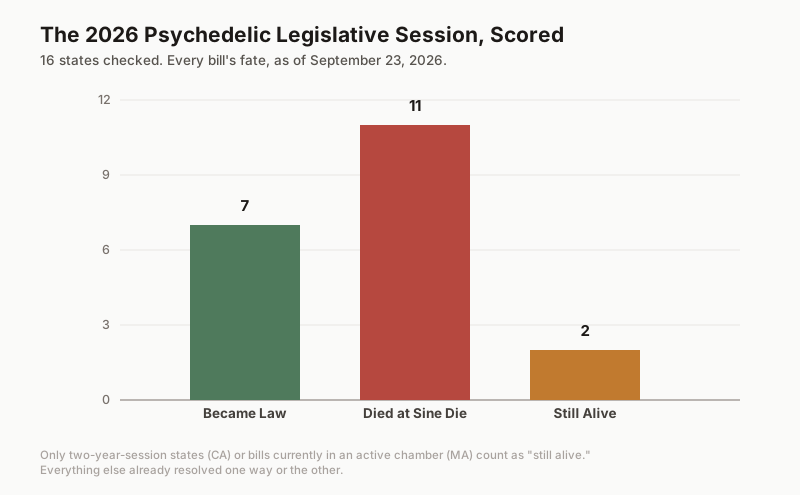
Most of the 2026 state legislative session is already over. We checked 16 states with active or recent psychedelic-related bills — direct from each legislature's own records, not secondary trackers — and the picture that emerges is less "here's what's pending" and more "here's how the year actually shook out": 7 bills became law, 11 died without ever reaching a floor vote, and only 2 states still have anything technically alive. Fourteen of the sixteen legislatures we checked have already adjourned for the year.
The 2 Still Alive
Massachusetts is the only state with real, active momentum. H.5562, the House's $561 million economic development bond bill, carries an amendment — championed by Rep. Marjorie C. Decker (D-Cambridge) — establishing a 5-year Department of Public Health pilot letting up to 3 licensed mental health clinics administer supervised psilocybin therapy for depression, anxiety, PTSD, and substance use disorder. Commercial psychedelic and pharmaceutical companies are explicitly barred from participating. It passed the House 148-2 on July 8, 2026, and now sits with the Senate. The underlying standalone bill is H.4200 (Rep. James J. O'Day, D-West Boylston), with Senate companion S.1400 (Sen. Cindy F. Friedman, D-Arlington). Five more related bills are alive in committee: H.2203 (Decker), H.2506 (Rep. Steven Owens), H.2532 (Rep. Lindsay N. Sabadosa), H.4050 (Rep. Patrick Kearney), and H.1624 (an entheogenic-plants task force).
California's AB 2489, the Veterans' Right to Try Act (Assemblymember Josh Lowenthal, D-Long Beach), would let the state's Research Advisory Panel file FDA IND applications for a 20-30 site trial of psilocybin, ibogaine, or other Schedule I/II substances in veterans ineligible for standard trials. It cleared Assembly Health 16-0 in April, then got parked in the Appropriations suspense file — its most recent action was an August 13 suspense hearing. California runs a two-year session, so the bill is still technically alive, but it needs release from suspense before the session's final adjournment or it dies as a failed two-year bill.
The 7 That Became Law
The real news of 2026 isn't what's pending — it's what already passed, much of it without wide coverage:
- Oregon HB 4110 — Oregon becomes the first state to legalize medical ibogaine, physician-supervised, effective January 1, 2027. Sponsors: Rep. Alek Skarlatos, Sen. David Brock Smith, Rep. Rob Nosse.
- Virginia HB1347 / SB379 — a "trigger law" directing the Board of Pharmacy to automatically reschedule any FDA-approved psilocybin formulation under state law. Passed the House 98-0; signed by Gov. Abigail Spanberger April 13, 2026 (Chapter 305). Sponsors: Del. Laura Jane Cohen and Sen. Jennifer Boysko.
- Connecticut SB-191 / Public Act 26-108 — extended and expanded the Yale/DMHAS MDMA-psilocybin pilot for veterans, first responders, and healthcare workers. Signed June 4, 2026.
- Utah HB390 — authorizes a Huntsman Mental Health Institute clinical study of MDMA, psilocybin, and 5-MeO-DMT for veteran PTSD. Passed unanimously. Sponsor: Rep. Jen Dailey-Provost (D-Salt Lake City).
- Colorado HB26-1325 — gives the Natural Medicine Division cease-and-desist authority against unlicensed operators. Effective August 12, 2026.
- New Mexico HB336 — allows FDA-approved synthetic psilocybin products under the state's existing Medical Psilocybin Act. Effective May 20, 2026; the program opened producer-permitting applications August 27.
- California SB1224 / AB113 — a budget trailer bill (absorbing Sen. Brian Jones's SB1224 language) funding $4.7 million for UC-based psilocybin, MDMA, and ketamine research for veteran PTSD. Signed by Gov. Newsom on September 18, 2026 — five days before this piece was reported.
The 11 That Died
This is where the lobbying money and the floor votes didn't line up, and where several of the year's more interesting stories are:
- Kansas HB2218 — this is Compass Pathways' own "trigger law" bill, requested by lobbyist Steve Kearney on the company's behalf, that would have pre-emptively rescheduled COMP360 under state law upon FDA approval. It cleared the House Health and Human Services Committee with amendments in January — then never got a floor vote before the legislature adjourned sine die April 11.
- Virginia SB1101 — would have created a state advisory council on psilocybin and MDMA for veterans. Passed the Senate 40-0. Then the House Rules Committee voted 18-0 to kill it without ever sending it to the Governor.
- Missouri HCS HBs 1717 & 1643 — psilocybin/ibogaine access for veterans and first responders, with $2 million in research grants attached. Passed the House 137-11 on April 2 — then sat on the Senate's informal calendar until it died at sine die on May 15, never getting a vote. A companion bill, SB1682 (Sen. Tracy McCreery), stalled in committee the same way.
- Washington SB5201 / HB1433 — would have created a regulated psilocybin service-center licensing system under the Department of Health. Died in committee.
- Washington SB5204 — a proposed 3-year University of Washington ibogaine study for opioid use disorder. Died in Senate Health & Long-Term Care.
- Washington SB5921 — a medical psilocybin program targeting a 2028 launch. Cleared its first committee, then died in Ways & Means.
- Vermont S.106, H.452, H.859 — extending the state's Psychedelic Therapy Advisory Working Group, decriminalizing psilocybin, and funding clinical trials, respectively. All stalled in committee; Vermont's biennium ended May 29, and unlike California, nothing carries over — these are dead, not dormant.
- California SB751 — an earlier veterans' psilocybin pilot (Sen. Josh Becker) that formally died in February, well before AB2489 or the September budget trailer bill picked up the thread.
Is This Partisan?
Not cleanly. We checked governor's party and legislative control for all 16 states, and the outcomes don't sort along party lines the way you'd expect:
| State | Governor | Legislature | Control | Outcome |
|---|---|---|---|---|
| Oregon | D | D | D trifecta | Became law |
| California | D | D | D trifecta | Became law + still alive |
| Washington | D | D | D trifecta | 3 bills died |
| Colorado | D | D | D trifecta | Became law |
| New Mexico | D | D | D trifecta | Became law |
| Massachusetts | D | D | D trifecta | Still alive |
| Connecticut | D | D | D trifecta | Became law |
| New York | D | D | D trifecta | Pending, dormant |
| Virginia | D | D | D trifecta | Became law + 1 died |
| Utah | R | R | R trifecta | Became law |
| Texas | R | R | R trifecta | Nothing pending in 2026 |
| Missouri | R | R | R trifecta | Died |
| Nevada | R | D | Divided | Nothing pending |
| Arizona | D | R | Divided | Nothing pending |
| Vermont | R | D | Divided | 3 bills died |
| Kansas | D | R | Divided | Died |
The sharpest contrast is Utah versus Washington: Utah is a full Republican trifecta, and its veteran-research bill passed unanimously. Washington is a full Democratic trifecta, and it killed three separate psychedelic bills in committee the same year. Virginia — a single-party Democratic trifecta — both signed a trigger law into existence and killed a companion bill in the same session. Full trifectas, either party, produced both outcomes. The only pattern with any real signal: none of the four divided-government states (Nevada, Arizona, Vermont, Kansas) passed anything, though Nevada and Arizona simply had nothing pending to begin with rather than an active bill getting killed. This looks much more like a story about committee gatekeeping, veterans'-issue framing, and individual sponsors than about party control.
A Note on Timing
If this reads more like a wrap-up than a "watch," that's deliberate and accurate: 14 of the 16 legislatures we checked have already adjourned for the year, and most won't reconvene until January 2027. A live "what's pending right now" tracker launched today would show almost nothing — not because the research is thin, but because the legislative calendar genuinely is. The real window for a running tracker opens with the new sessions in January, when this year's dead bills get refiled and the cycle starts again. We'll be watching for that.
This is policy and legislative reporting, not legal advice. Bill status reflects each state legislature's own published records as of September 23, 2026, and can change with any new legislative action.
Sources
- Massachusetts H.5562, H.4200, S.1400
- California AB2489 status, SB751 status
- Oregon HB4110 overview
- Virginia HB1347
- Utah HB390
- Colorado HB26-1325
- New Mexico HB0336
- Kansas HB2218; Kansas Reflector: Compass Pathways requests preemptive law change
- Marijuana Moment: Virginia House panel kills SB1101
- Missouri SB1682 tracking; Missouri Independent: House passes veterans psilocybin bill
- Washington SB5201, SB5204
- Altitude: Which Psychedelic-Company CEO's Pay Actually Matched Their Stock's Performance?
- Ballotpedia: State Government Trifectas