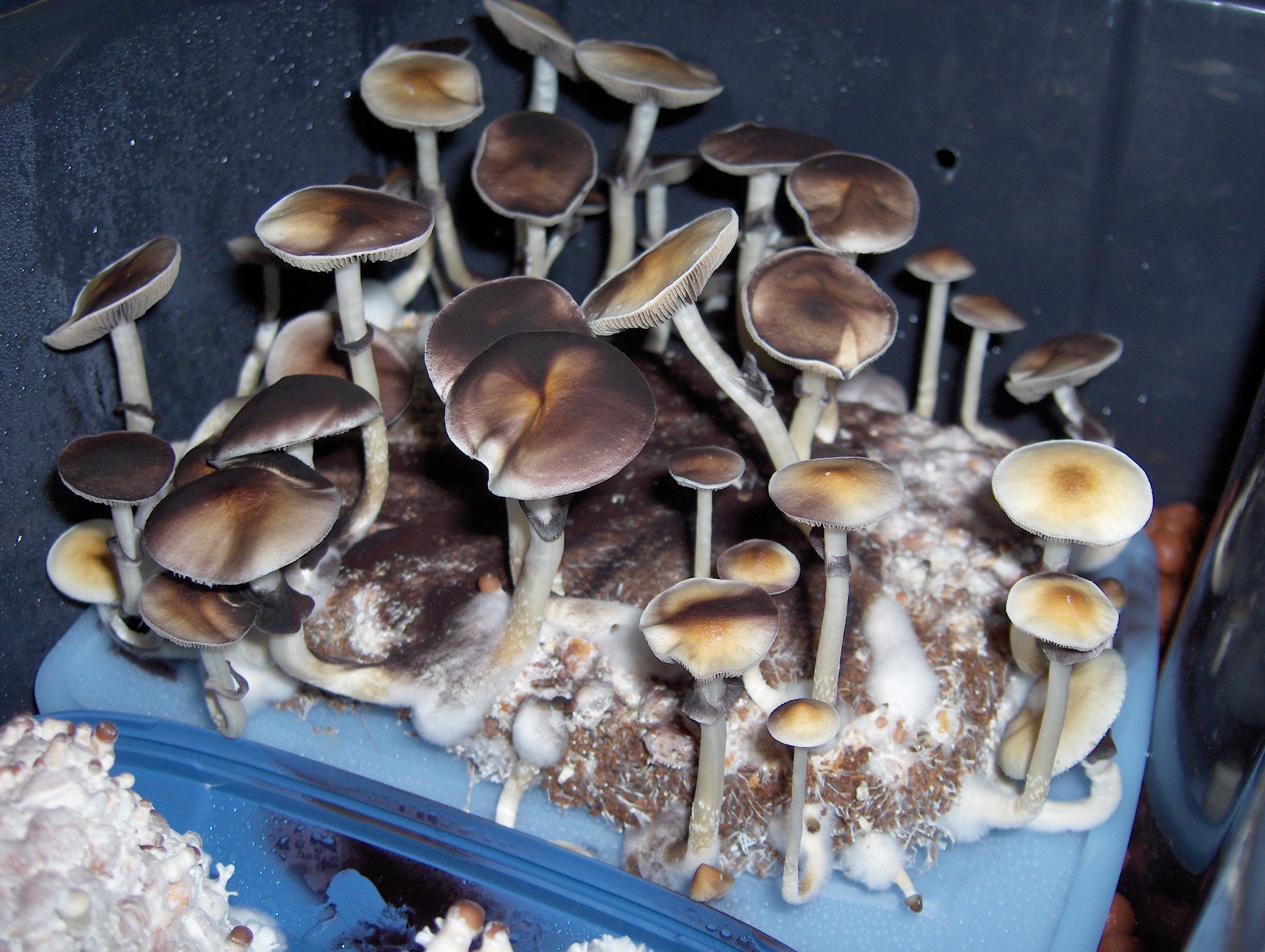
Photo: Psilocybe cubensis mushrooms, by Ilkka S. Itäheima, via Wikimedia Commons (attribution license).
This is Week 3 of the Altitude People Series, four installments on named public figures who've talked about their own psychedelic use. Week 1 covered sports and Week 2 covered politicians. This week is business, and celebrities close the series next Wednesday.
Business is where the experience most often turned into money. And no one has turned one psychedelic experience into more of it than Christian Angermayer.
Christian Angermayer: "The Single Most Meaningful Thing"
Angermayer, a German investor, didn't drink and didn't use drugs. A doctor told him psilocybin was less dangerous than alcohol, and in the mid-2010s he tried mushrooms with friends. It was, he told STAT's Meghana Keshavan, "the single most meaningful thing I've ever done or experienced in my life. Nothing has ever come close to it."
He built an industry on it. He was one of the first investors in Compass Pathways when it started in 2016, alongside Peter Thiel and Mike Novogratz. In 2017 he co-founded atai Life Sciences, which by 2019 owned about a quarter of Compass, STAT reported. Compass's psilocybin application went to the FDA this week.
The money. Atai went public in 2021 at $15 a share and fell to around $2. Angermayer's investment firm, Apeiron, kept buying. SEC filings show it bought about 10.8 million shares at $2.10 in February 2025 and another 8.7 million at $2.19 that August. In November 2025, atai merged with Beckley Psytech, which was developing a nasal spray form of 5-MeO-DMT. Eight months later, Eli Lilly agreed to buy the combined company for $6.75 a share in cash, about $2.8 billion, plus up to $1 billion more tied to milestones. The deal closed on Sept. 11. Forbes' Will Yakowicz reported that Angermayer, with roughly 15% of the company, stood to collect about $360 million before taxes, on top of roughly $100 million of his own money he'd put into the field.
In his words, by drug:
| Drug | What he's said | Source |
|---|---|---|
| Psilocybin | "The single most meaningful thing I've ever done or experienced in my life." On safety: "It's very gentle and has very little side effects." | STAT; MAHA Summit, via The MAHA Report |
| DMT | Argued that DMT's short duration may make it the most effective option in many cases, compared with a six-hour psilocybin session (paraphrased by The MAHA Report) | The MAHA Report |
| LSD | Has passed on it for drug development because a session runs about 14 hours (paraphrased by The MAHA Report) | The MAHA Report |
| 5-MeO-DMT | No direct quote we could find. It's the drug behind the Lilly deal: BPL-003, a nasal spray in Phase 3 for treatment-resistant depression | Lilly |
| Psychedelics overall | "I think this could be the key to global mental sanity." | The MAHA Report |
In Washington. Angermayer's advocacy has been public. In November 2025 he spoke at the MAHA Summit in Washington on a psychedelic medicine panel led by Matt Zorn, the HHS deputy general counsel who has become the administration's point person on psychedelics (we covered Zorn here). "We need to have a tool ready, psychedelics, to help us move from one era in our lifetime into the next one," he told the audience. In 2019 he pledged about $250,000 to a MAPS project on psychedelics and Israeli-Palestinian reconciliation. "I'm not all about money," he told STAT. "I'm about peace, too."
Who Else Has Gone on Record
| Name | Substance(s) | Status | Context | Bio | Source (Journalist) |
|---|---|---|---|---|---|
| Christian Angermayer | Psilocybin | On Record | Co-founder of atai; early Compass investor; sold to Eli Lilly in 2026 | Wikipedia | STAT — Meghana Keshavan; The Daily Beast — Tarpley Hitt |
| Steve Jobs | LSD | On Record | Apple co-founder (died 2011); told his biographer LSD shaped his sense of what mattered | Wikipedia | Walter Isaacson, Steve Jobs (2011), via The Fiscal Times — Maureen Mackey |
| Sam Altman | Unspecified psychedelics | On Record | OpenAI CEO; says a guided weekend retreat in Mexico ended years of anxiety | Wikipedia | "Life in Seven Songs" podcast, via Fortune — Chloe Berger |
| Bob Parsons | Psilocybin, ayahuasca, LSD | On Record | GoDaddy founder and Marine veteran of Vietnam; guided psychedelic therapy for decades-old PTSD | Wikipedia | The Daily Beast — Noah Kirsch; Forbes — Will Yakowicz |
| Tim Ferriss | Psilocybin | On Record | Author and investor; used mushrooms for depression as a Princeton student, now a major research donor | Wikipedia | Chronicle of Philanthropy — Marc Gunther |
| Bryan Johnson | Psilocybin | On Record | Braintree founder turned longevity entrepreneur; took about five grams of mushrooms on a public livestream in November 2025 | Wikipedia | The San Francisco Standard — Ezra Wallach |
| Sergey Brin | Psilocybin | Reported | Google co-founder; reported to "sometimes enjoy magic mushrooms"; his foundation has since backed an ibogaine startup | Wikipedia | The Wall Street Journal — Kirsten Grind and Katherine Bindley (June 2023) |
Status key: On Record means the person's own words, in an interview, on their own record, or reported by a named journalist who interviewed them directly. Reported means credible reporting from people familiar with it, not confirmed by the person.
Steve Jobs: "One of the Most Important Things in My Life"
Jobs told Walter Isaacson, for the 2011 biography, that "taking LSD was a profound experience, one of the most important things in my life," and said it reinforced his sense that the point was to create great things rather than make money. Our LSD patent deep dive covers where the compound is now headed: Definium plans to file for FDA approval of an LSD tablet in the first half of 2027.
Sam Altman: "And It Really Did"
Altman told the "Life in Seven Songs" podcast he'd been a "very anxious, unhappy person" until a guided weekend retreat in Mexico. "If you had told me that one weekend-long retreat in Mexico was going to significantly change that, I would have said absolutely not. And it really did." He now feels like "a very calm person," Fortune's Chloe Berger reported. He didn't name the substances. The experiences that changed his life, he said, were the ones where "you go travel to a guide."
Bob Parsons: "Finally Brought Me Home"
Parsons came back from Vietnam with a Purple Heart and PTSD that he says lasted for decades. He described guided sessions in Hawaii in 2018 to The Daily Beast's Noah Kirsch, including a pot of psilocybin tea meant for three people, which he drank by himself. "It was psychedelic-assisted therapy that finally brought me home after all those years," he told Mount Sinai, where he and his wife Renee have since funded what is now the Parsons Research Center for Psychedelic Healing, focused on veterans. Their latest gift there was $5 million.
Tim Ferriss: "Push All My Chips In"
Ferriss told the Chronicle of Philanthropy's Marc Gunther that as a depressed and anxious Princeton student, psilocybin let him "finally see things clearly." After his childhood best friend died of a fentanyl overdose, he pledged $2 million of his own money to psychedelic research and helped fund Johns Hopkins' work on psilocybin for opioid addiction. "These compounds are by no means a panacea," he said. "But they show tremendous promise for serious conditions that currently have few or no effective treatments."
Bryan Johnson: A Trip as a Data Point
Johnson, who sold the payments company Braintree in 2013 and now runs the "Don't Die" longevity project, took about five grams of psilocybin mushrooms on a public livestream with guests including Salesforce's Marc Benioff, tracking his biomarkers throughout. "I felt I was equal to the task," he said, as reported by The San Francisco Standard's Ezra Wallach, "and then I was accepted into this gorgeous gift of existence." No independent results from his measurements have been published.
Sergey Brin: Reported, and Backing Ibogaine
Brin has never described his own use publicly. The Wall Street Journal reported in 2023, citing a person familiar with the matter, that the Google co-founder "sometimes enjoys magic mushrooms." What's on the record is his money. His foundation, Catalyst4, put about $15 million into Soneira, a startup working on ibogaine for traumatic brain injury, the Financial Times reported in 2024. That's the same compound the politicians in Week 2 went to Mexico for, and the subject of our ibogaine deep dive.
What Connects Them
None of the seven describe recreational use. Each ties psychedelics to something specific: anxiety, trauma, depression, purpose. And this is the group in the series with the money to act on it. Angermayer is the clearest case. One trip led to a decade of investing, an early stake in the company whose psilocybin application is now at the FDA, and a payout from Eli Lilly.
Next Wednesday, the series closes with celebrities.
This is journalism about public figures' own statements, not medical advice. Psilocybin, LSD, DMT, 5-MeO-DMT and ibogaine remain Schedule I under federal law, none is FDA-approved, and using them outside a clinical or legally regulated setting carries real risks.
Sources
- Meghana Keshavan, "The psychedelics evangelist: A German financier wants to turn magic mushrooms into modern medicine," STAT, July 1, 2019
- Tarpley Hitt, "Billionaire German Investor Christian Angermayer Says Mushrooms Are Key to His Success," The Daily Beast, April 23, 2021
- Will Yakowicz, "This Billionaire Made $360 Million Selling His Psychedelic Company to Eli Lilly," Forbes, July 24, 2026
- Eli Lilly and Company, "Lilly to acquire AtaiBeckley," July 16, 2026
- Dick Russell, "At the MAHA Summit: Will Psychedelics Become a Key to Mental Stability?" The MAHA Report, Nov. 18, 2025
- Apeiron Investment Group, SEC Form 4 filings for atai Life Sciences, February and August 2025
- Maureen Mackey, "Steve Jobs: 10 Revealing Quotes From His Biography," The Fiscal Times, Oct. 24, 2011 (quoting Walter Isaacson, Steve Jobs)
- Chloe Berger, "Sam Altman says psychedelic experience significantly changed him," Fortune, Sept. 25, 2024
- Noah Kirsch, "GoDaddy Billionaire Bob Parsons Details His Four-Day Psychedelic Trip," The Daily Beast, Feb. 19, 2024
- Will Yakowicz, "GoDaddy Billionaire Bob Parsons Believes Psychedelics Can Heal Trauma," Forbes, April 2022 (archived by MAPS)
- Mount Sinai, "Bob and Renee Parsons," Jan. 7, 2025
- Marc Gunther, "Tim Ferriss on Giving for Psychedelic Research: It's Personal," The Chronicle of Philanthropy, April 30, 2019
- Ezra Wallach, "Bryan Johnson's mushroom livestream," The San Francisco Standard, Dec. 1, 2025
- Kirsten Grind and Katherine Bindley, "Magic Mushrooms. LSD. Ketamine. The Drugs That Power Silicon Valley," The Wall Street Journal, June 27, 2023
- Fortune, "Sergey Brin is using money from selling his Tesla shares to bankroll a startup developing hallucinogenic mental health treatments," July 23, 2024 (citing the Financial Times)
- Photo: Psilocybe cubensis indoor, Ilkka S. Itäheima, Wikimedia Commons (attribution license)