
Every psychedelic-industry headline leans on the same three words — Phase 1, Phase 2, Phase 3 — as if the reader already knows what separates them, how many people are involved, or what actually has to happen for a trial to count as a win. Most coverage, including some of ours, doesn't stop to explain it. This is the explainer: what each phase actually requires, what "success" legally means, why psychedelics broke the standard playbook badly enough that FDA had to write a new one, and — because nobody ever asks this part — who's paying for all of it.
What the Three Phases Actually Require
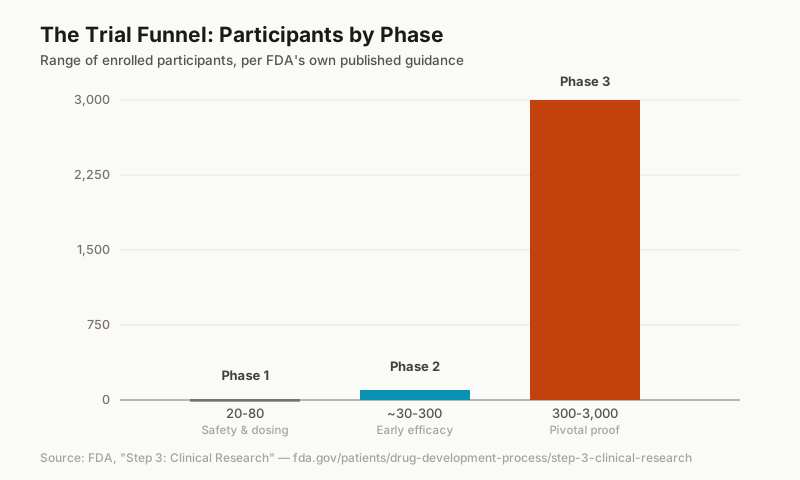
| Phase | Primary Goal | Typical Participants | Typical Duration | What "Success" Means |
|---|---|---|---|---|
| Phase 1 | Safety, dosing, how the body processes the drug | 20-80 | Months | No unacceptable toxicity; a tolerable dose range identified |
| Phase 2 | Early signal that the drug actually works | ~30-300 | Several months to ~2 years | A measurable effect on the target condition, worth testing at scale |
| Phase 3 | The pivotal, confirmatory proof | 300-3,000 | 1-4 years | Beats placebo on a pre-specified primary endpoint, at statistical significance |
That table is FDA's own published framework, not an industry convention — a company can't simply decide its own trial counts as "Phase 3." The NIH's clinical trial glossary is a useful plain-language companion if you want the definitions without the regulatory language.
There's No "Required Success Rate" — There's a Pre-Registered Bar
This is the most commonly misunderstood part of trial reporting: there is no FDA-mandated percentage of patients who have to improve. What's actually required is that the drug beats placebo on one primary endpoint, chosen and locked in before the trial starts, at a pre-set statistical threshold — conventionally p<0.05, meaning there's no more than a 1-in-20 chance the result is random noise. Trials are sized in advance through a power calculation, usually targeting 80-90% statistical power: enough participants that if the drug's real effect is roughly what researchers expect, the trial is very likely to detect it. FDA's own guidance on multiple endpoints is the primary source for why sponsors fight so hard to protect that one pre-specified endpoint — hitting a secondary measure instead doesn't count as winning the trial, no matter how good the underlying data looks in a press release.
Why Psychedelics Broke the Standard Playbook
A normal drug trial hides the treatment behind an inert placebo, and nobody — patient, doctor, or rater — is supposed to be able to tell who got what. Psychedelics make that nearly impossible: a patient who spends eight hours seeing color trails and dissolving ego boundaries knows within minutes they didn't get the sugar pill. FDA's own July 2026 guidance, "Psychedelic Drugs: Considerations for Clinical Investigations," names this directly as functional unblinding, and lays out what sponsors now have to do about it:
- Active controls instead of inert placebo — a low dose of the same psychedelic, or a different psychoactive drug that mimics part of the subjective experience, rather than a pill that does nothing at all
- Blinded central raters — outcome assessors who never interact with the patient in person and don't know which arm they're in
- Blinding and expectancy questionnaires — measuring how well the blind actually held, instead of assuming it did
- Long-term blinded follow-up, typically 12 months, with pre-specified rules for when a patient can be re-dosed
- Factorial designs when psychotherapy is administered alongside the drug, to separate the drug's own effect from the therapy's
Applied Clinical Trials Online and King & Spalding's analysis both frame this the same way: a genuinely higher evidentiary bar than a standard CNS drug clears, not a lighter one — which cuts directly against the "psychedelics get a regulatory pass" narrative that shows up in some coverage.
Four Compounds, Four Different Points in the Process
| Compound | Lead Program | Company | Current Phase | Key Trial(s) | Latest Result |
|---|---|---|---|---|---|
| 5-MeO-DMT | GH001 (inhaled mebufotenin) | GH Research (Nasdaq: GHRS) | Phase 2b complete | GH001-TRD-201, 81 patients | -15.5 pt placebo-adjusted MADRS reduction, p<0.0001; 57.7% remission |
| Psilocybin | COMP360 | Compass Pathways (Nasdaq: CMPS) | Two positive Phase 3 trials | COMP005 (258 pts), COMP006 (568 pts) | Both hit primary endpoint; rolling NDA submission underway |
| LSD | DT120 | Definium Therapeutics (Nasdaq: DFTX) | Two positive Phase 3 trials | Voyage, Panorama | Both hit primary endpoint for GAD; full coverage |
| Ibogaine | Cardiac-safer ibogaine derivative | DemeRx (private) | Phase II/III | Multi-site US trial, opioid use disorder | First-ever FDA IND for an ibogaine-class compound |
Ibogaine is the outlier worth explaining: no company had a drug candidate far enough along to interest Texas, so the state is funding its own $50 million research program through UTHealth Houston and UTMB Health — running pharmacology, cardiac-safety, and efficacy work in parallel rather than waiting on a single sponsor. Stanford's separately-run MISTIC trial is investigating ibogaine for opioid use disorder on its own track. Track all four compounds' full trial history on our Trials Tracker and their patent position on our Patent Tracker.
The Economics Nobody Talks About
| Cost Category | What It Actually Covers | Typical Figure |
|---|---|---|
| Participant compensation | Stipends, travel, time — psychedelic trials pay more because of multi-hour supervised dosing sessions | $500-$6,000 per participant |
| Investigator/physician payment | Per-patient grant paid to the treating physician and site | ~$6,900/patient average, wide variation by specialty |
| Site start-up | IRB/ethics review, contracts, training, technology setup | $3,500-$7,500+ per site |
| Ongoing site management | Continued monitoring, admin, and coordination | ~$1,500 per site, per month |
| CRO & data monitoring | Contract research organizations running multi-site execution | Industry-wide CRO spend grew from $10.4B to $78.6B, 2000-2020 |
| FDA application fee | The PDUFA fee for a full NDA requiring clinical data | $4,682,003 (FY2026 rate) |
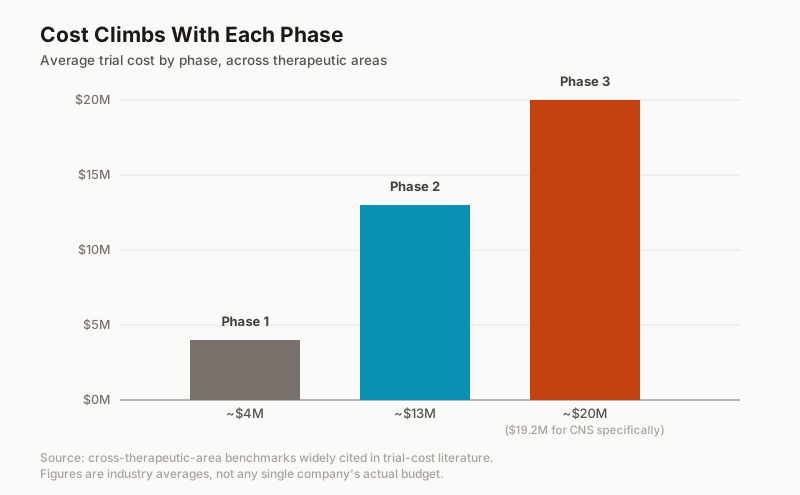
| Average trial cost | Direct cost, across therapeutic areas | ~$4M (Phase 1) → ~$13M (Phase 2) → ~$20M (Phase 3) |
That last row is a genuine average, not a psychedelic-specific number — nobody has published a clean psychedelic-trial breakdown at this level of detail yet, largely because so few have reached Phase 3. The bigger, more contested figure sits above all of this: what it costs to take one drug from lab to approval, full stop. Tufts CSDD's widely-cited estimate is $2.6 billion, built from 106 drugs and including the opportunity cost of capital tied up for years. A 2017 JAMA Internal Medicine study by Prasad and Mailankody put the median at $648 million for cancer drugs specifically — using actual company financial filings rather than confidential industry-supplied data. Tufts' own Joseph DiMasi called that analysis "irredeemably flawed" over selection bias in which companies it sampled. Both critiques have real merit, and neither number should be read as a settled fact — treat the true figure as somewhere in a very wide range, the same caveat we've applied to market-size estimates elsewhere on this site.
What Recruitment and Tracking Actually Look Like From the Inside
I have some firsthand experience with this machinery. I was a participant in Pfizer's Phase 3 COVID-19 vaccine trial — something I talked about with Dr. Yella Hewings-Martin, Medical News Today's senior research editor, and pharmacist Lindsay Slowiczek of Healthline Media, on Medical News Today's "In Conversation" podcast — and it exposed me to how recruitment and tracking actually work: screening calls, site visits, symptom diaries, follow-up scheduling, long before any of it becomes a topline press release. I was randomized into the placebo group. Once the vaccine cleared emergency authorization in December 2020, Pfizer didn't leave us there for the full blinded follow-up period — the company moved up its timeline for offering the real vaccine to placebo recipients rather than making us wait it out. It's a real, lived version of the exact tradeoff FDA's psychedelic guidance is trying to get ahead of with its pre-specified retreatment criteria, above: at what point does protecting the blind for scientific integrity become unfair to the people who agreed to risk getting nothing?
What This Actually Means for Reading the News
None of the four compounds above is FDA-approved for anything yet. Two — psilocybin and LSD — have cleared the pivotal bar twice each, which is meaningfully further than a single positive readout; one, 5-MeO-DMT, has a strong Phase 2b signal that still has to survive the jump to Phase 3, the single most expensive and highest-attrition step in the entire process; and ibogaine doesn't have a company-led program advanced enough to name a phase at all, which is exactly why a state government stepped in to fund the science itself. The next time a press release says "positive Phase 3 results," the honest read is: it beat a pre-registered statistical bar, in a trial that likely cost on the order of $20 million to run, inside a regulatory framework that — for this drug class specifically — was rewritten this year because the old rulebook couldn't actually tell if the blind was real.
This is educational and business reporting, not medical or investment advice. No compound discussed here is FDA-approved for any indication. Cost and participant figures are industry averages drawn from the cited sources, not confirmed budgets for any specific company or trial.
Sources
- FDA: Step 3 — Clinical Research
- NIH NCATS: Phases of Clinical Trials
- FDA: Multiple Endpoints in Clinical Trials — Guidance for Industry
- FDA: Psychedelic Drugs — Considerations for Clinical Investigations (July 2026)
- STAT News: Pfizer and BioNTech Speed Up Timeline for Offering COVID-19 Vaccine to Placebo Volunteers
- Medical News Today: "In Conversation" — Volunteering for a COVID-19 Vaccine Trial
- Applied Clinical Trials Online: FDA Finalizes Guidance on Clinical Trial Design for Psychedelic Drug Development
- King & Spalding: FDA's New Psychedelic Drug Guidance Paves a Path to Approval While Setting a High Evidentiary Bar
- GH Research: Phase 2b Primary Endpoint Results, GH001
- Compass Pathways: COMP005 and COMP006 Phase 3 Results
- UTHealth Houston: $50 Million Texas Ibogaine Clinical Trials
- ClinicalTrials.gov: Stanford MISTIC Trial (NCT05660447)
- Applied Clinical Trials Online: Tufts CSDD — Cost to Develop New Drug Is $2.6B
- PubMed: Research and Development Spending to Bring a Single Cancer Drug to Market (Prasad & Mailankody, 2017)
- Applied Clinical Trials Online: Benchmarking Investigator Payments
- Federal Register: Prescription Drug User Fee Rates for Fiscal Year 2026
- Altitude: Trials Tracker
- Altitude: Patent Tracker